

Working out a snake’s gender can feel confusing, especially if you’re new to reptiles. Effectively sexing a snake often depends on age, species, and experience. This guide explains what’s possible, what’s not, and when it’s best to ask for professional help.
Jump to:
- Why do you need to know a snake’s gender?
- Do snakes have both sex organs?
- What should I think about before trying to sex a snake?
- How do you sex a snake?
- Can snakes change sex?
- Insure your snake today
Why do you need to know a snake’s gender?
Knowing your snake’s gender is an important part of being a good owner and understanding how to effectively look after your scaly friend. It can help with:
- Housing decisions
- Breeding plans
- Long-term care expectations
- Conversations with vets and insurers about health risks that may differ between males and females
Do snakes have both sex organs?
No, snakes don’t have both sex organs. They’re either biologically male or female.
- Male snakes have a pair of reproductive organs called hemipenes (penises), which are internal and not visible externally
- Female snakes don’t have hemipenes and instead have a reproductive system suited to egg-laying or live birth, depending on the species
What should I think about before trying to sex a snake?
Unlike cats or dogs, snakes don’t have obvious external differences between sexes. This can make the process feel uncertain and, at times, frustrating.
But it’s very important to remember that incorrect handling or DIY techniques can cause stress or injury to your snake.
Before attempting to check a snake’s gender, it helps to think about:
- The snake’s age – young snakes are harder to sex accurately
- Your experience level with reptiles
- Whether the information is essential right now
In many cases, waiting or seeking professional help is the safest option. Your snake’s welfare should always come first.
How do you sex a snake?
There are a few different methods to sex a snake, but not all are suitable for beginners:
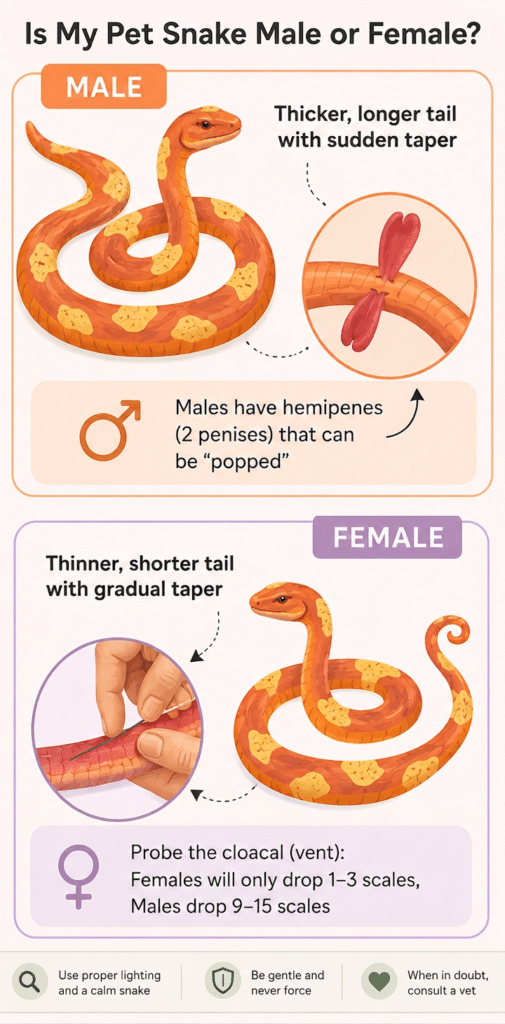
- Probing – a tool is gently inserted into the cloaca (an opening near the base of the tail) to check depth
- Popping – light pressure is applied to turn reproductive organs outwards in young snakes
- Visual and size clues – used only for certain species and adults
Probing
This technique should only be carried out by trained professionals as it can cause serious internal injury if done incorrectly.
Many vets and experienced breeders use probing because it’s more reliable, but even then, training and the right equipment are essential.
Here’s how a vet does it:
- The snake is calmly restrained to reduce stress and movement.
- A smooth, rounded metal probe of an appropriate size is chosen.
- The probe is gently inserted into the cloaca and directed towards the tail tip.
- The depth the probe travels is observed.
- The probe is carefully removed and the snake is checked for signs of discomfort.
How the sex is decided:
- Male snakes – the probe passes deeper (because it goes into one of the hemipenal pockets)
- Female snakes – the probe only goes a short distance
Popping
Again, this option should only be carried out by a trained professional so as not to apply excess pressure to the snake.
Here’s how a professional carries it out:
- The snake is gently restrained, usually belly-up.
- Light pressure is applied just behind the cloaca.
- Pressure is directed forward and upward in a controlled way.
- The cloacal area is observed during the movement.
How the sex is decided:
- Male snakes – one or both hemipenes briefly pop out
- Female snakes – nothing protrudes
It’s important to note that popping doesn’t always give reliable results. This is why probing or veterinary imagery is used as these techniques are seen as safer and more consistent.
Visual clues
Visual sexing relies on observation, comparison, and experience. While it’s the least invasive option, it can also be the least reliable when used alone, especially for certain species such as ball pythons.
Visually checking a snake’s sex is often used to support other techniques. Professionals will usually do this when the snake is fully mature and is a species with well-documented sexual differences.
To make a visual diagnosis, a vet or experienced breeder will:
- Observe the snake while they’re calm and relaxed
- Assess their overall body length, build, and proportions
- Pay particular attention to the tail shape and thickness
- Visually examine the area just beyond the cloaca
- Compare all of this against known sex traits for that species and, when possible, with others of the same species and age
Here’s what they’re looking at:
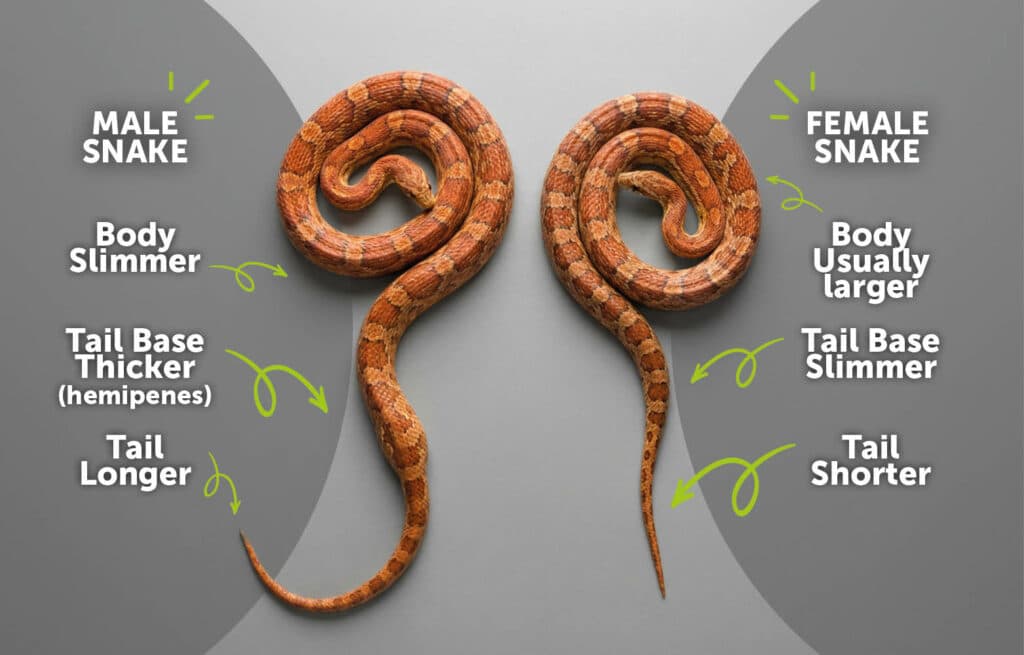
Tail length
- Males often have longer tails beyond the cloaca
- Females’ tails usually taper more quickly
Tail thickness
- Male tails may appear thicker due to internal hemipenes
- Female tails tend to look slimmer and more uniform
Body size and shape
- In some species, females grow larger or heavier as adults
- Males may appear slimmer with proportionally longer tails
The welfare-focused approach
An approach that is more focused on the welfare of your snake is to:
- Ask a reptile vet to confirm the sex
- Use breeder records if available
- Accept that some snakes can’t be reliably sexed until maturity
Can snakes change sex?
No. Snakes can’t change sex. They’re born either male or female and don’t switch sex due to social or environmental reasons (like some other species can).
Confusion about a snake’s gender can happen because:
- Young snakes can be difficult to sex accurately
- Some species mature slowly
- Errors in early identification can later appear as ‘changes’
- In rare cases, snakes may have developmental abnormalities that make sex harder to work out
If you’ve been given conflicting information about your snake’s gender, it’s more likely due to an earlier misidentification than a biological change. Seeking a second opinion from a reptile-experienced vet can help clear things up.
Insure your snake today
Part of being a responsible snake owner, aside from safely finding out their sex, is making sure you’ve got cover in place if they become ill.
With years of experience insuring exotic pets, Exotic Direct can help you find the right snake insurance for your scaly friend.
FAQs
Is it safe to check a snake’s gender at home?
Visual observation is generally the safest way to check a snake’s gender at home, although it isn’t always reliable. Invasive methods should always be left to trained professionals.
At what age can a snake be sexed?
Some snakes can be sexed when they’re young by experienced professionals, but accuracy generally improves as they mature.
Does a snake’s gender affect its temperament?
A snake’s gender doesn’t usually affect its temperament. Personality, species, and handling have a much greater influence on behaviour.