

Choosing the right setup for your tortoise is important for its health, comfort and wellbeing. From selecting a suitable enclosure to getting the heating and lighting right, providing the correct environment will help your tortoise thrive. Here’s what you need to know to create a safe and comfortable home for your pet.
Jump to:
- What equipment do you need for a tortoise?
- Tortoise table vs. vivarium: which is best?
- Setting up your tortoise’s enclosure
- Tortoise heat lamps and UV lights for Mediterranean tortoises
- Tortoise table temperature and heat management
- How to increase humidity on a tortoise table
- Food and water
What equipment do you need for a tortoise?
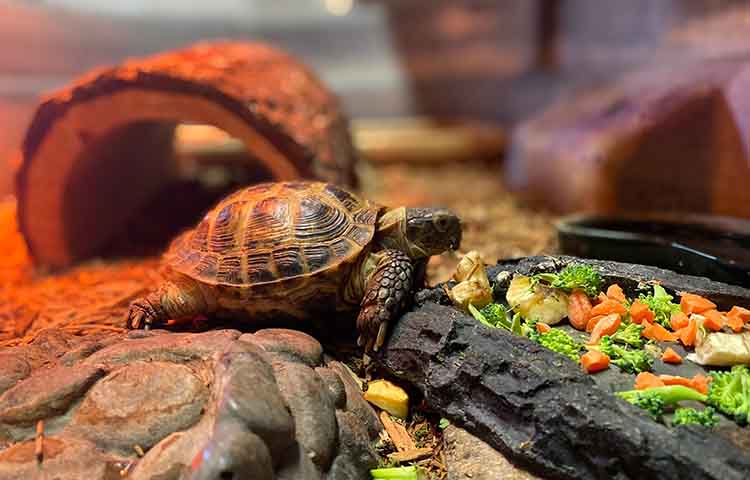
For your tortoise, you will need:
- A suitable enclosure
- An appropriate heat source and thermostat
- An ultraviolet (UV)-emitting light
- A safe substrate
- Hides for the enclosure
- Special food and water bowls
- Thermometers
Tortoise table vs. vivarium: which is best?
In recent years, tortoise tables have become the recommended option for hatchling and young tortoises. They tend to be larger than enclosed vivariums, making it easier to create a thermal gradient. Their open design also makes it easier to hand-feed and tame your tortoise.
There are various tortoise table designs available, but it’s worth purchasing a relatively large one from the start. This will give your tortoise plenty of room and save you from having to replace the enclosure in the future.
One important design aspect to consider is the height of the sides. You don’t want your tortoise tumbling over them and falling to the ground, so the sides should be around 25cm (10in) high. It’s also important to avoid placing items such as hides next to the corners of the table, as these could provide a platform for your tortoise to climb up and over the sides.
Horsfield’s tortoises, in particular, are very effective climbers, possibly because they come from fairly rocky areas. So, if you have one of these tortoises, take extra care to make sure there are no easy escape routes.
A tortoise table is suitable for all European-type tortoises, including:
- Mediterranean spur-thighed tortoises (Testudo graeca)
- Hermann’s tortoises (Testudo hermanni)
- Marginated tortoises (Testudo marginata)
- Horsfield’s (also known as Afghan) tortoises (Agrionemys horsfieldii)
Vivariums can be a better option for some species. Maintaining humidity is generally easier in an enclosed vivarium, which is why they are still more commonly used for young tropical tortoises that originate from humid environments.
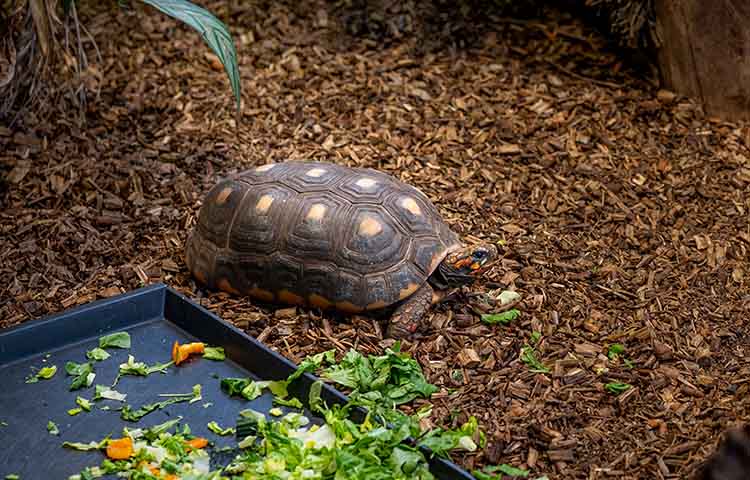
One example is the red-footed tortoise (Chelonoidis carbonarius), which originates from parts of South America. If you choose a vivarium for your tortoise, it’s best to go for the largest design possible.
Setting up your tortoise’s enclosure
Best substrates for tortoises
You can now find specially prepared substrates at reptile outlets, including options recommended for Mediterranean tortoises. Topsoil was traditionally used as a floor covering for tortoise tables, but there are now substrates specifically made for tortoises that should be safe to use.
Avoid sand, as your tortoise could accidentally swallow particles with its food, which may cause an intestinal obstruction.
How often should you change the substrate?
You do not need to change the substrate very frequently. Typically, this only needs to be done every few months, although regular spot-cleaning is essential.
A tool designed for cleaning a cat litter tray can be useful for this purpose, but make sure you keep it exclusively for use with your tortoise.
How deep should the substrate be?
The substrate should cover the floor area to a depth of about 5cm (2in), particularly as tortoises like to burrow down into it.
Do I need waterproof liners for tortoise tables?
No, you don’t need a waterproof liner, as the substrate should never become soaked. That said, a liner can make changing the substrate easier, as you can simply lift it out when it’s time for a change.
Tortoise hides
It is important to provide a retreat for your tortoise in both the warmer and cooler parts of the enclosure.
This will help your tortoise feel secure. Young tortoises are naturally shy and will hide under grass in the wild to escape predators.
What plants can I put on my tortoise table?
There are various plants you can use, but they must be non-toxic and must not have been treated with toxic chemicals, either directly or indirectly.
Indirect contamination can occur when plants are grown in compost containing systemic insecticides that are absorbed by the plants, or when they have been sprayed with chemicals. Garden centres may sometimes sell plants that have been treated in this way.
Ask your local reptile store for safe, organically grown options, such as turtle vine (Callisia repens), which many tortoises enjoy nibbling on. Make sure the pot is secure and cannot topple over onto your pet.
You can also place small trays of weeds grown using tortoise seed mixes on top of the substrate, allowing your pet to nibble on these too.
Tortoise heat lamps and UV lights for Mediterranean tortoises
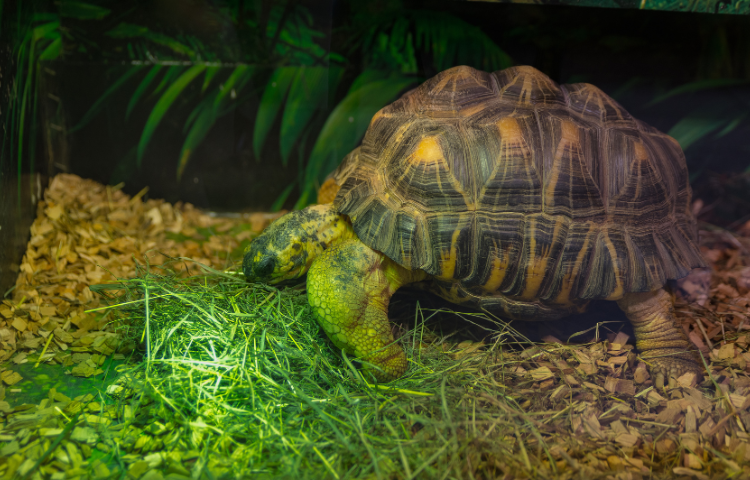
A combination (or ‘combi’) lamp that provides both heat and UV light is probably the best option for a tortoise table, as it allows you to provide both from a single source. You’ll need to position it at the correct height using a suitable stand.
You can also keep heating and lighting separate by using an infrared (IR) heat source and a UV tube above your tortoise’s enclosure. There are a few types of IR heat sources to choose from, and the wattage you’ll need will depend partly on how warm the room is.
If you’re unsure which option is best for your setup, your tortoise breeder or local reptile store should be able to advise you. You can also check the packaging of reptile-specific products for guidance on positioning and installation.
UV lighting for tortoises
When using separate UV lighting, a T5 12% tube positioned 40–60cm (15–24in) from the top of your tortoise’s shell while it is basking is a popular choice. A T8 12% tube can be positioned closer, at around 30–40cm (12–15in).
Whichever type you choose, always read the instructions carefully to make sure the UV lighting is set up and used safely.
UV light output gradually decreases over time, but as we can’t see UV wavelengths, there’s no way to tell by looking at a bulb or tube when it needs replacing. Manufacturers generally recommend changing them every 10–12 months to maintain their performance and ensure your tortoise continues to receive these important wavelengths, which would naturally come from the sun.
Some manufacturers also offer free text reminders when you register your purchase, so you’ll know when it’s time to replace the bulb.
Heating for tortoises
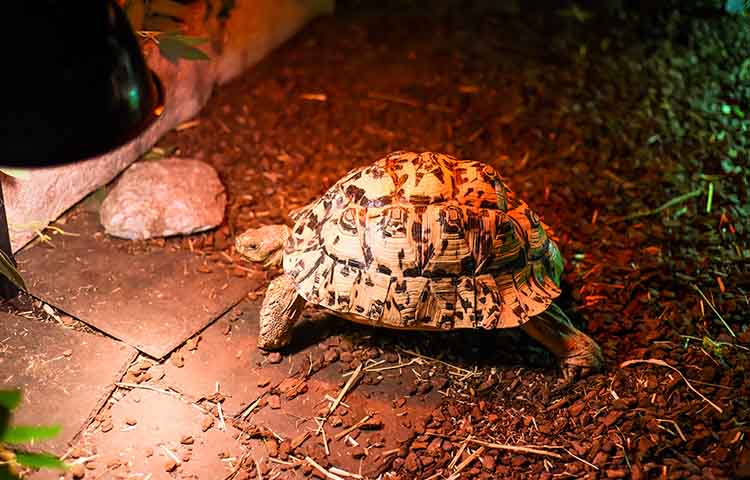
There are several heating options available for tortoises.
Ceramic infrared (IR) dull emitters
Aside from a combi lamp, you can choose from other types of heat sources, including ceramic IR dull (heat) emitters. These only emit IR wavelengths, so a separate UV source will be essential.
Ceramic IR dull emitters get very hot and need to be housed in a suitable ceramic socket and operated with a pulse-proportional thermostat.
They are very dependable units, with a life expectancy of 10 years or more, and are particularly useful in large enclosures.
Ceramic IR dull emitters have a different design from typical rounded lamps. They are flat at the end furthest from the socket.
IR lamps
IR lamps are another option for providing your tortoise with essential warmth. These can be used safely on a 24-hour basis under thermostatic control, provided they have suitable fittings.
Unlike ceramic emitters, they have a much shorter life expectancy, similar to that of a typical light bulb.
Some IR lamps also provide UVA, but they don’t produce UVB, so they cannot be used as a complete lighting system for your tortoise.
Halogen bulbs
Some halogen bulbs are designed for vivarium use and sold through reptile outlets. These are only suitable for daytime use.
Only certain types of halogen bulb produce UVA, so make sure you read the packaging carefully.
Night-time bulbs
If your tortoise needs extra warmth overnight, special night-time bulbs are available that provide heat without visible light. This means you can maintain a suitable temperature without introducing light into your tortoise’s enclosure during the night.
When choosing a bulb, also check the fitting type. Most reptile lamps have a screw fitting, while some use a bayonet fitting, so make sure you choose a suitable holder.
Tortoise basking lamp holders
A special holder with a surrounding cover, known as a reflector, is usually used to fit the lamp. The reflector directs the light down into your tortoise’s enclosure, concentrating it in the right area.
It is also recommended to fit a screen over the reflector to minimise the risk of accidentally burning yourself on the bulb, although the reflector itself is also likely to become hot.
What is the difference between IR, UVA and UVB?
Each of these wavelengths plays a different role in your tortoise’s heating and lighting requirements:
- Infrared (IR): Provides warmth.
- UVA: Helps stimulate appetite and supports vision.
- UVB: Is vital for the production of vitamin D3 in your tortoise’s skin.
Vitamin D3 enables the body to absorb and metabolise calcium, which is used for healthy bones and the formation of eggshells, for example.
When choosing your lighting system, consider the different wavelengths your tortoise needs and the size of its enclosure. You can provide them using separate bulbs and tubes or an all-in-one combi lamp.
Tortoise table temperature and heat management
Tortoise table temperature
As a guide, the temperature under the heat source should be 32–35°C (90–95°F), with the opposite end of the enclosure being no lower than 20°C (68°F).
You need to create a thermal gradient across your tortoise’s enclosure. This allows your tortoise to move closer to the heat source when it feels cold and further away once it has warmed up.
This mimics the basking behaviour tortoises display in the wild. Tortoises depend on their environmental temperature to maintain their activity levels.
Does a tortoise need a heat lamp at night?
In most cases, your tortoise won’t need additional heating overnight, unless the room temperature drops too low. If this happens, you may need to provide some background heat to maintain an overnight temperature of around 15–18°C (60–65°F).
A heat mat is another option, provided it is controlled by a thermostat and mounted on the wall of the enclosure. Remember that your tortoise does not need visible lighting or UV light at night.
Thermometers
You can position thermometers at the warmer and cooler ends of the tortoise table to measure the temperature gradient.
A digital IR laser thermometer (temperature gun) can also be used to provide instant readings.
How long should the heat lamp and UV light be on?
In general, provide your tortoise with warmth and light for 8–10 hours every day, corresponding to the usual daylight hours. Provided the UV source is working effectively, this should meet your tortoise’s UV requirements.
Do tortoises need a heat mat?
Thin heat pads are sometimes used with tortoises, but these should not be placed on the floor of the enclosure. Instead, attach them to one side so they act like a radiator.
They can be useful for providing gentle background heat overnight. They should always operate under thermostatic control. As with all electrical equipment, only buy branded products from well-known manufacturers to help ensure they are safe to use.
Tortoise table thermostats
A thermostat is an essential piece of equipment. It regulates the heat output so that your tortoise’s enclosure does not become too hot or too cold.
There are three basic types of thermostat:
- On/off thermostat: The most basic type, which simply switches the heat source on and off.
- Dimming thermostat: A more sophisticated type, where the light level (and therefore the heat output) adjusts according to the temperature probe.
- Pulse-proportional thermostat: The most accurate type, which adjusts rapidly to temperature fluctuations. It is also the most expensive option.
Tortoise light timer
A light timer isn’t a must-have, but it can make life a little easier. For example, if you are late getting home, the light above your tortoise table will still switch off at the pre-set time.
How to increase humidity on a tortoise table
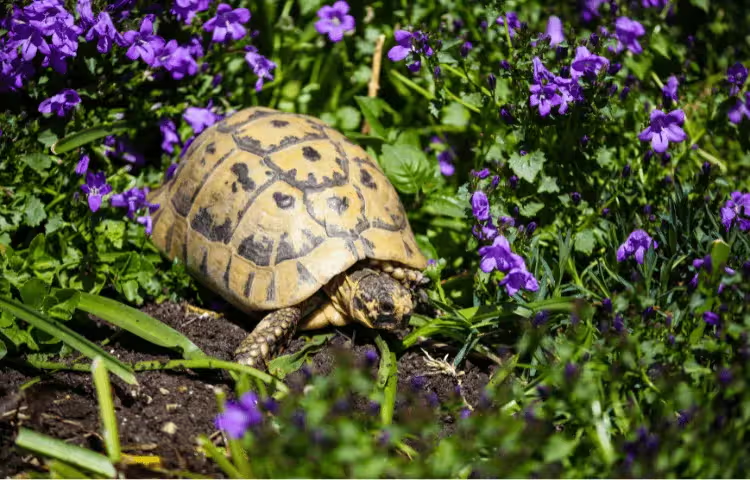
During winter, when central heating is often on, the air inside your home can become quite dry. Regularly spraying your tortoise’s enclosure with tepid water can help increase humidity, but take care to avoid electrical equipment. To be safe, briefly switch off any equipment before spraying.
You can also add some moss to one of the hides and spray it with water to help retain moisture. It’s important to maintain suitable humidity, as air that is too dry may contribute to shell pyramiding in young tortoises, a condition that causes abnormal shell growth.
Food and water
Do tortoises need a water bowl?
Your tortoise must always have access to a shallow but stable water bowl.
Be prepared to change the water and clean the container daily. The bowl may get dirty if your tortoise soaks in it, as it can drag substrate into the water.
Where should I position the food bowl?
Keep the food bowl away from the hottest part of the enclosure.
It is a good idea to place it on a tile or piece of slate. This means that if your tortoise pulls a piece of food out of the bowl, it will not get dragged into the substrate.
Creating a happy home for your tortoise
Creating the right home for your tortoise doesn’t have to be complicated. With a suitable enclosure, the right heating and lighting, and plenty of space to explore, hide and feed, you can help your pet feel comfortable and settled. Keep an eye on temperatures, clean the enclosure regularly and make sure your tortoise always has access to fresh water. A little care with their setup will go a long way towards supporting their health and wellbeing.
Don’t forget about tortoise insurance
Even with the right care and setup, tortoises can sometimes need veterinary treatment. Tortoise insurance can help with eligible vet fees, giving you extra support if your pet becomes ill or has an accident. This can give you one less thing to worry about when your tortoise needs a little extra care.